
For generations, the standard Australian housing trajectory involved moving out, purchasing a suburban block, and raising a family independently. Today, that conventional route is effectively closed for many. A combination of an ageing population, persistent cost-of-living increases, and an undeniably severe housing affordability crisis has forced a national rethink on how we occupy property.
The reality of this crisis was starkly outlined during the Federal Budget on 13 May 2026. As Treasurer Jim Chalmers highlighted, property values have surged by more than 400 per cent since 1999, a growth rate that more than doubles average income increases. While the government announced 5 per cent deposit schemes to assist first home buyers, the core issue persists: young Australians are structurally priced out of the established housing market.
Faced with these barriers, families are pivoting to a deeply established global housing model: multigenerational living.
Recent data from AMP indicates that 55 per cent of Australians now support the idea of extended families sharing a single property to consolidate expenses. Furthermore, the 2021 Census recorded 335,000 households where three or more adult generations cohabit.
However, successfully housing multiple generations requires far more than simply converting a garage. It demands absolute privacy, structural independence, and intelligent spatial design. This is precisely why modular housing, specifically the SUCASA® range has emerged as the definitive solution for families wanting to share land without sacrificing their lifestyle, while simultaneously offering young Australians a viable entry point into homeownership.
This guide provides clear, transparent information regarding the use of modular homes for multigenerational living. We explore the structural advantages, outline the realities of local council planning, and detail the critical questions you must ask any builder before committing your money.
The Drivers Behind Australia’s Multigenerational Shift
The transition toward shared family properties is not a temporary reaction; it is a structural change driven by three major national factors.
Housing Affordability and the First Home Buyer Challenge
Breaking into the property market is an immense hurdle for younger demographics. To address this, the 2026 Federal Budget heavily skewed tax incentives toward new construction.
From July 2027, negative gearing will be strictly limited to newly built properties. Capital gains tax discounts will also heavily favour new housing supply.
Because of this, constructing a modular secondary dwelling on family-owned land is now a highly strategic move. It is a tax-efficient method for parents to help adult children secure a brand-new home. Best of all, it entirely avoids the crushing debt associated with buying an established house.
The Ageing Population
Australia is experiencing a rapid demographic shift. Over the next decade, citizens aged 85 and older will increase by 67 per cent, surpassing one million people.
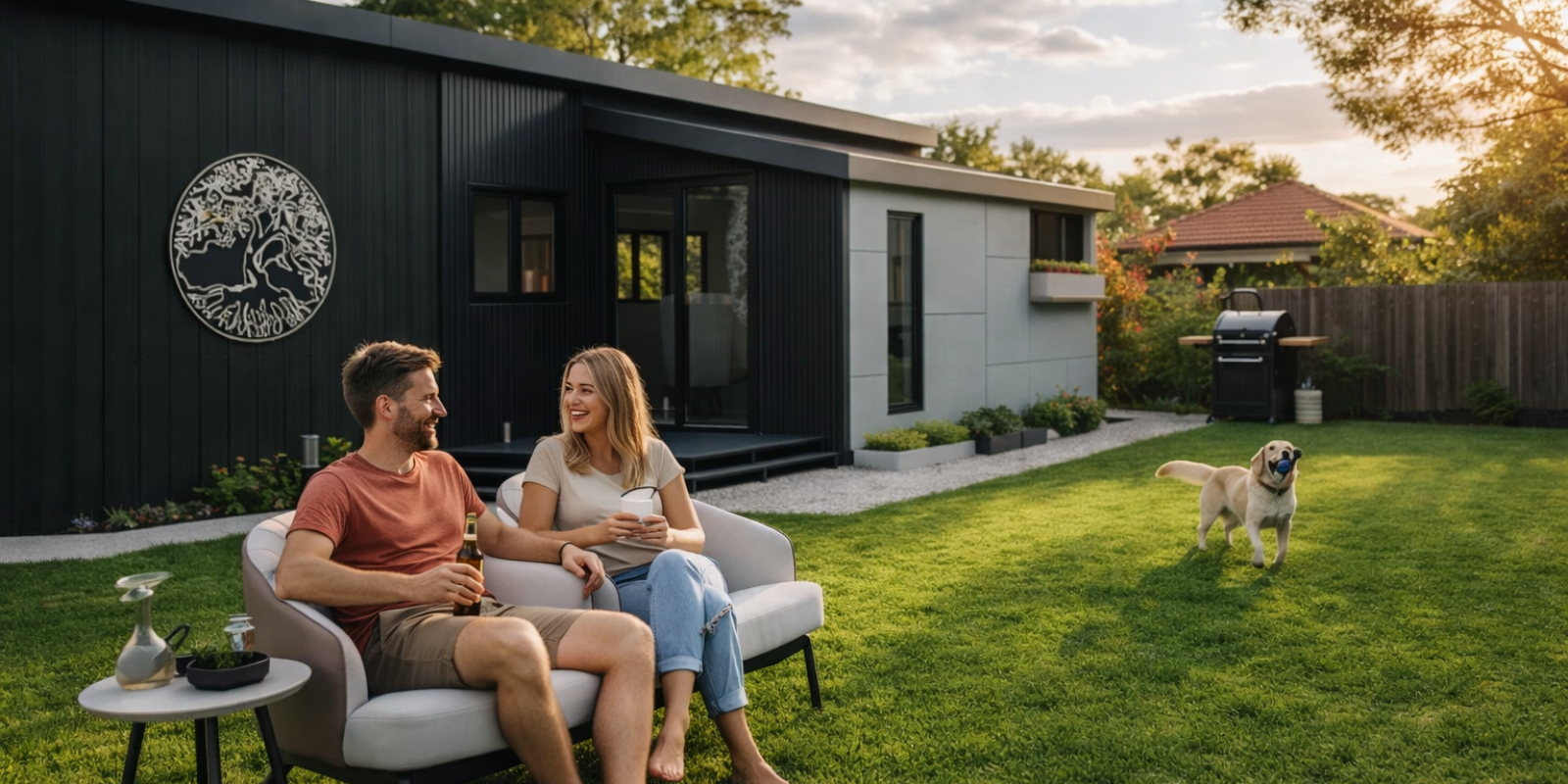
Rather than engaging with the complex, costly aged care sector, families are facilitating independent living on their own property. This strategy ensures elderly parents maintain their autonomy while staying merely steps away from family support.
Cultural Alignment
Australia is a diverse nation where almost one in three citizens was born overseas. Because of this, we are embracing cultural housing norms. Many migrant families arrive with strong traditions that normalise and celebrate extended family units living on a shared estate.
Delivering Absolute Privacy Through Premium Modular Design
The primary risk in multigenerational living is the erosion of personal boundaries. Maintaining healthy family dynamics requires distinct, separate living spaces.
Historically, adding a secondary dwelling meant enduring a year-long construction process. It turned a quiet backyard into a chaotic building site. Premium modular construction bypasses this disruption entirely.
The Off-Site Advantage
Because these homes are built within a controlled factory environment, the heavy building phase occurs off-site. Once completed, the structure is transported via truck and craned directly onto permanent footings. This method condenses on-site disruption from several months down to just a few weeks.
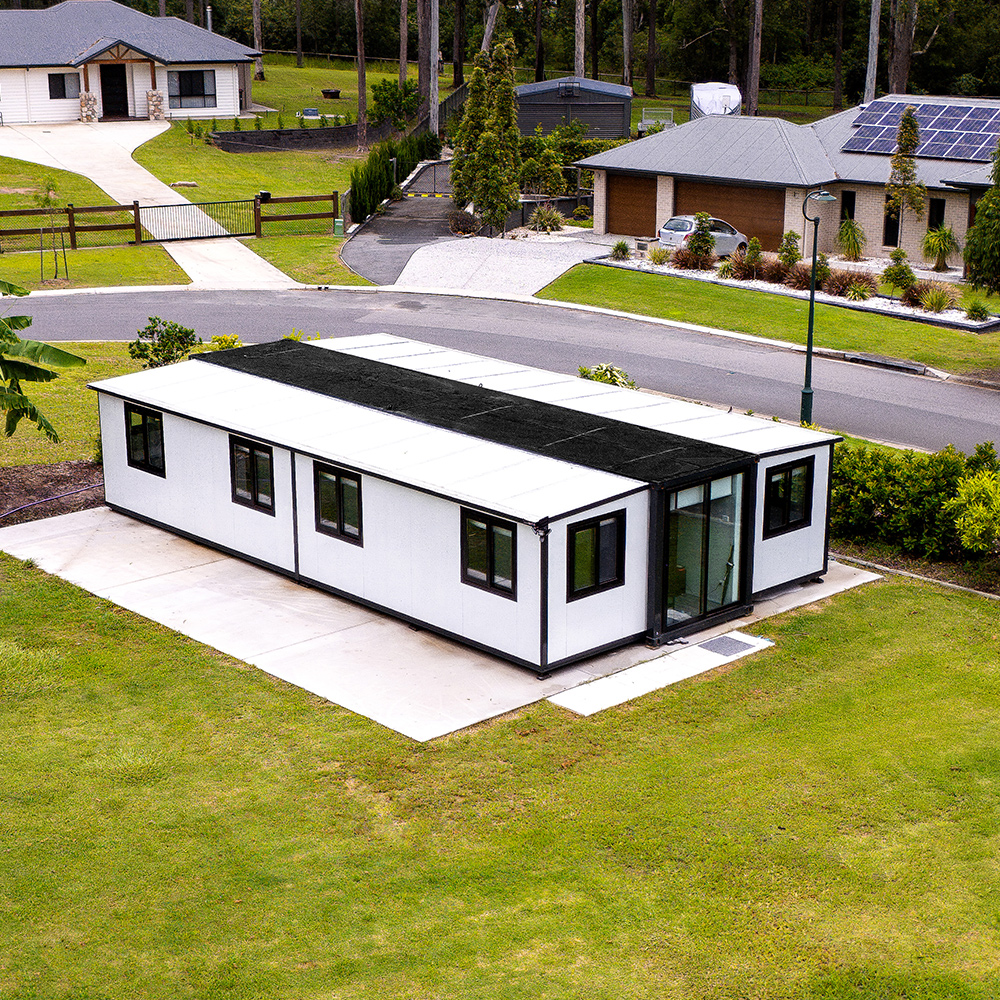
Crucially, a residential-grade product like the SUCASA® range is not a lightweight cabin or a flat-pack kit. It is a highly engineered structure built to the exact same National Construction Code (NCC) requirements as any traditional suburban house.
Understanding NCC Compliance
The National Construction Code (NCC) sets the strict building standards for homes across Australia.
When we state that a SUCASA® modular home is “Class 1a NCC Compliant”, it means the Australian government officially categorises it as a permanent, standalone residential house. It passes the exact same rigorous tests for structural strength, fire resistance, energy efficiency, and waterproofing as a custom brick home.
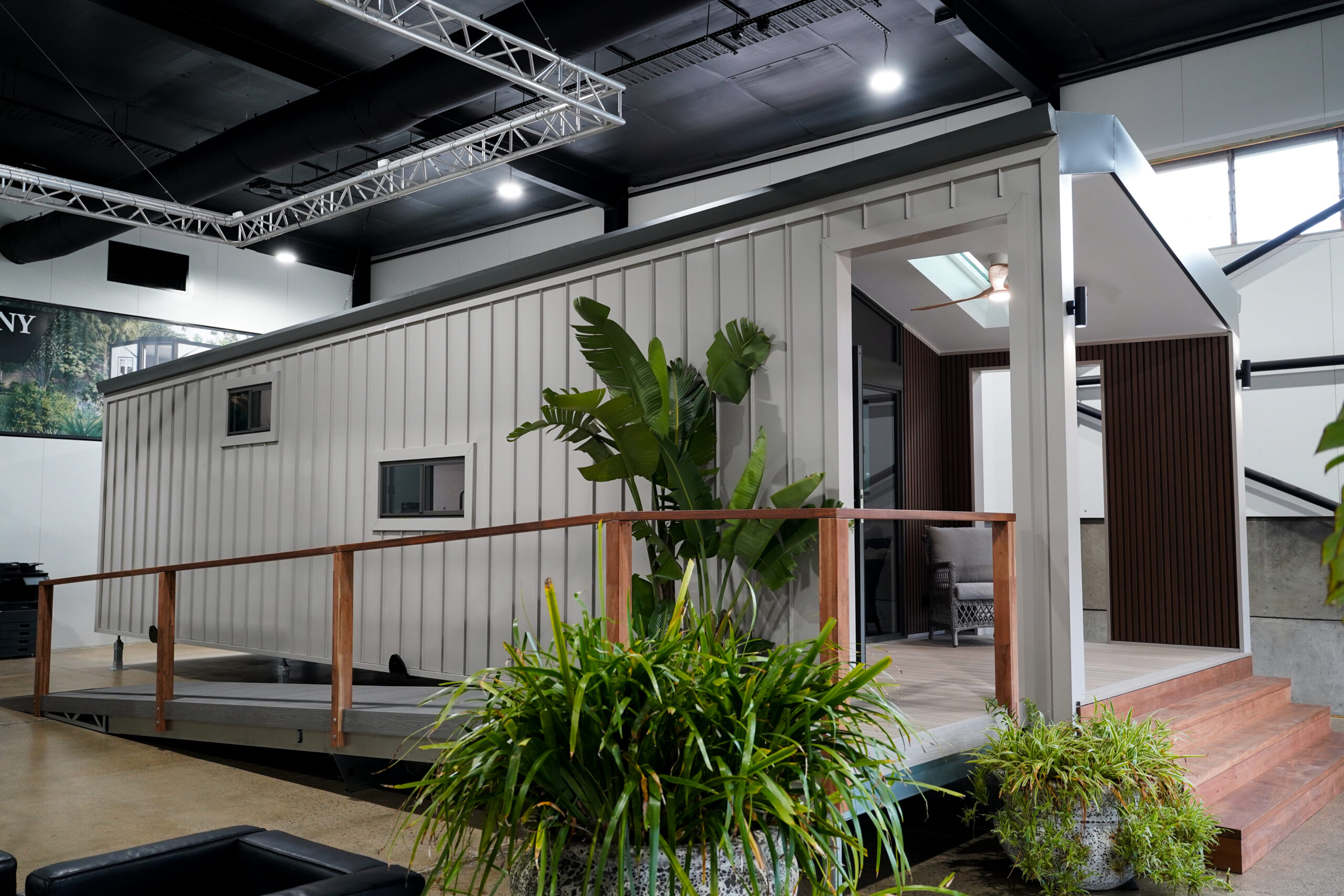
When you walk through the front door, it looks, feels, and functions exactly like a permanent house. It features high-quality insulation, full-scale kitchens, and exceptional energy ratings.
What about Council Regulations?
Gaining approval to build a secondary dwelling is not an automatic guarantee. Suggesting that a modular home can be placed in any Australian backyard is factually incorrect.
Local government regulations for secondary dwellings (commonly known as granny flats) differ significantly based on your state, your specific council, and your property’s zoning. The table below outlines the general regulatory landscape
| State | General Stance on Secondary Dwellings | Key Considerations |
| New South Wales | Generally supportive | In many cases, granny flats may qualify for a Complying Development Certificate (CDC), which can provide a faster approval pathway compared with a full DA process for lots exceeding 450m² and dwellings under 60m² . |
| Victoria | Recently relaxed | Victoria has introduced reforms intended to simplify approvals for smaller secondary dwellings in some circumstances.
|
| Queensland | Varies heavily by council | Some Queensland councils, including Brisbane, permit larger secondary dwellings (up to 80m²) subject to zoning and planning requirements.
|
| South Australia | Strict definitions | Frequently mandates shared utilities with the primary residence and enforces rigid size limitations under the Planning and Design Code. |
| Western Australia | Varies heavily by council | Specific minimum lot sizes apply, ranging from 350m² to 450m² depending entirely on the local government area. |
Note: This information serves as a general guide. Council regulations and approval requirements vary between states, councils, zoning categories, and individual properties. Homeowners should seek independent advice from their local council, private certifier, or qualified town planner before proceeding.
The Reality of Siting and Setbacks
Setback regulations are a frequent obstacle. Councils strictly control the required distance between a new dwelling and the existing house, as well as the side and rear boundary fences.
A standard requirement is a 900mm clearance from side boundaries, though this fluctuates based on building height and fire safety codes. If a property is unusually shaped or particularly small, a modular home may simply not fit within the legal parameters.
If your property cannot accommodate a build, we will tell you directly. We prioritise honest assessments over selling a product that cannot be legally installed.
Three Non-Negotiable Questions for Any Builder
When evaluating modular options for your family, you must look beyond marketing materials. To safeguard your investment, demand clear answers to these three critical questions from any prospective builder:
- Is the structure officially Class 1a compliant?
Do not accept vague assurances. Class 1a classification confirms that the dwelling is designed to meet the NCC requirements for a residential home. Without this specific certification, local councils may deem the building a temporary structure, rendering permanent residential approval almost impossible.
- Where is the manufacturing facility, and what are the Quality Assurance protocols?
Because construction happens off-site, you cannot monitor daily progress. You must ask exactly where the home is built and how quality is verified.
At My Little House, we manufacture the SUCASA® range entirely within our Australian warehouse facilities. Backed by 40 years of hands-on construction experience, we enforce rigorous, documented Quality Assurance (QA) inspections at every phase of the build, long before the home is dispatched.
- Do you manage the entire project from inception to handover?
The town planning process is notoriously complex. Many businesses employ excellent sales staff to help you select a floorplan, only to abandon you when it comes time to secure council permits and coordinate site works.
Always clarify if the builder manages the full scope of works. We oversee the entire SUCASA® process from start to finish—handling the planning applications, securing building permits, and managing site coordination—because we understand how overwhelming council bureaucracy can be for homeowners.
Securing Your Family’s Future
Opting for a multigenerational living arrangement is a highly strategic financial and lifestyle choice. It empowers families to consolidate their finances, provide immediate care for ageing parents, and offer younger Australians a genuine pathway to homeownership amid a severe housing crisis.
Provided your property has the necessary space and zoning, a compliant Class 1a modular home stands as the most effective method for establishing an independent residence. It delivers the permanence and privacy of a standard build, while eliminating the protracted stress of a traditional construction site.
Conduct thorough research, verify your local zoning laws, and partner with a builder who offers complete transparency and full-service project management. When you are prepared to invest in a high-quality modular solution, we possess the expertise to deliver a home your family will value for decades.
Frequently Asked Questions:
1.Can I use a modular home for multigenerational living in Australia?
Yes. Premium modular homes constructed to Class 1a building standards are legally recognised as permanent residential houses. They serve as an ideal solution for multigenerational living, offering a fully independent secondary residence on a shared block, provided the local council zoning permits the addition.
2. Can I put a modular home on my parents’ property?
In the majority of cases, yes, assuming the land meets the local council’s specific criteria for a secondary dwelling (frequently referred to as a granny flat). Homeowners must verify minimum lot size requirements, boundary setback rules, and whether the council mandates a full planning permit or solely a building permit.
3. Can my parents live in a modular home on my land?
Yes. This arrangement is a highly popular method for facilitating independent living for elderly relatives. A Class 1a modular home delivers a permanent, highly comfortable environment that allows parents to retain their autonomy while staying close to family support networks. Appropriate council approvals must be secured prior to installation.
4. Is a modular home a good option for ageing in place?
Yes. Because they are engineered to the National Construction Code, modular homes can be customised for accessibility. They provide the structural integrity and premium finish of a traditional site-built house, resulting in a secure, long-term residential solution for elderly family members.
5. How close can a modular home be to the main house?
This metric is entirely dependent on local council regulations and mandatory fire safety standards. Secondary dwellings must adhere to specific boundary setbacks (commonly requiring a 900mm clearance from side fences). Homeowners must engage a local certifier or their council to confirm the exact siting regulations for their specific property.
6. What are the council rules for a secondary dwelling?
Regulations for secondary dwellings fluctuate significantly across Australian jurisdictions. States such as New South Wales and Victoria have introduced streamlined approval pathways for structures under 60m². Conversely, other states delegate all regulatory power to individual local councils, which enforce their own maximum floor areas, minimum block sizes, and rental restrictions. Always verify the rules with your specific local government authority.